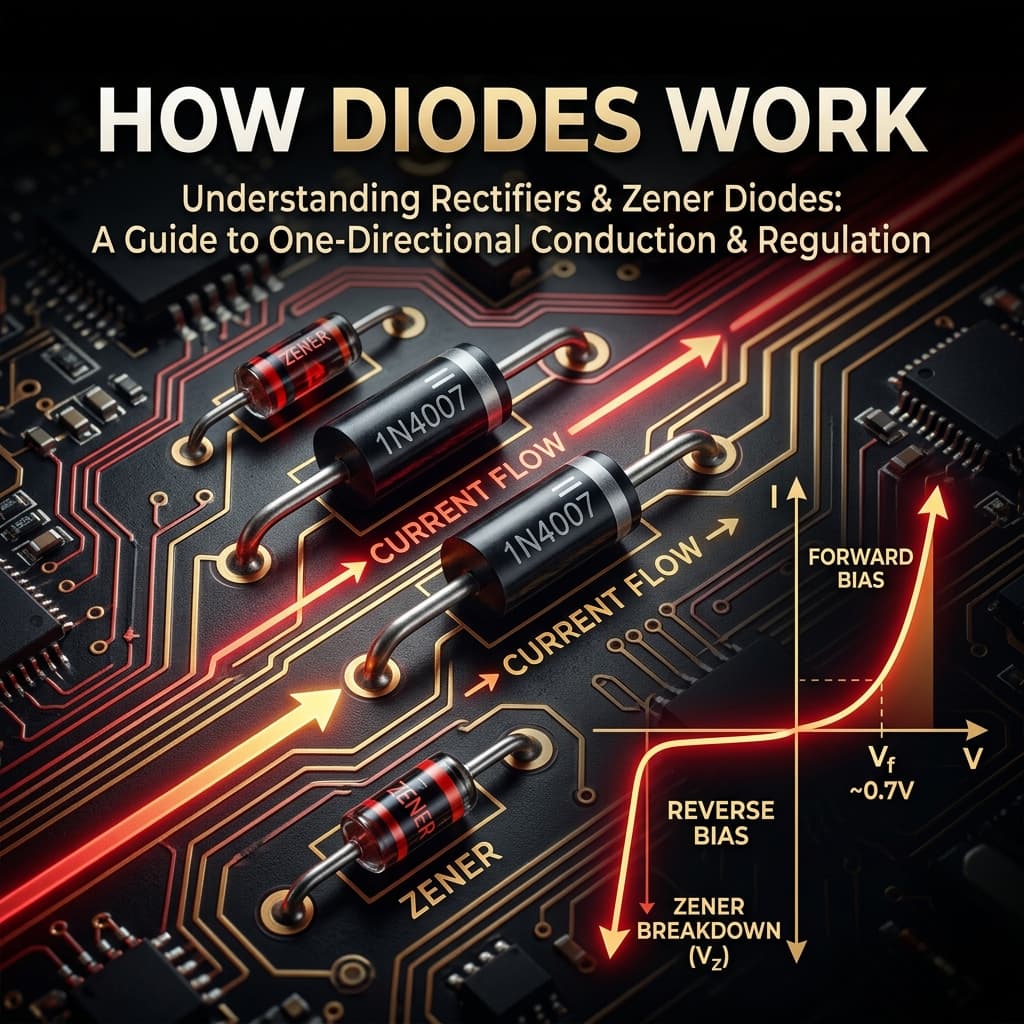
The PN Junction: How a Diode Is Made
- [PN junction] [creates] [depletion region barrier voltage ~0.7V]
- [Forward bias] [overcomes] [depletion barrier enabling current flow]
- [Reverse bias] [widens] [depletion region blocking all current]
When P-type and N-type silicon are joined, electrons diffuse from N to P and holes from P to N until a depletion region forms — an area devoid of free charge carriers with a built-in potential of ~0.7V for silicon. Apply forward bias (+ to anode, − to cathode) above 0.7V and you collapse this barrier; apply reverse bias and you widen it, blocking current flow.
Diode Types: Rectifier vs Zener vs Schottky vs LED
🔴 Rectifier (1N4007)
General-purpose. 1A, 1000V PIV, 30 µs recovery. Used in AC-DC power supplies, flyback protection, reverse polarity protection.
🟡 Zener (BZX55C5V1)
Operates in controlled reverse breakdown. 5.1V reference voltage regardless of current (within limits). Used for voltage clamping, references, and simple regulators.
⚡ Schottky (1N5819)
Metal-semiconductor junction. 0.3V forward drop, ~10 ns recovery. Used in switch-mode supplies, OR-ing circuits, solar blocking diodes, RF detection.
💡 LED
Emits photons at forward junction recombination. Forward voltage varies by color: IR=1.2V, Red=1.8V, Green=2.1V, Blue=3.2V, White=3.3V.
Zener Diode Voltage Regulator: How It Works
A Zener shunt regulator uses a series resistor and a Zener diode to clamp an output voltage. When input voltage rises, more current flows through the Zener (it burns off the excess as heat), maintaining a constant output voltage equal to the Zener voltage.
- Choose Zener voltage: Select Vz slightly above your target output (e.g., BZX55C5V1 = 5.1V for a 5V reference).
- Series resistor: R = (Vin − Vz) / (Iz_max + IL_max). Ensures enough current to keep Zener in breakdown while limiting maximum Zener dissipation.
- Load connection: Load connects in parallel with the Zener. Voltage across load = Vz ± tolerance.
Frequently Asked Questions
How does a diode work in simple terms?
A diode is a one-way valve for electricity. Current flows freely when forward-biased (anode positive, cathode negative) above ~0.7V. In reverse bias, the depletion region widens and blocks current until reverse breakdown voltage is reached.
What is the difference between a Zener diode and a regular diode?
Regular diodes are destroyed by reverse breakdown. Zener diodes are designed for it — they clamp the reverse voltage to a precise value (Zener voltage) and are used as voltage references and shunt regulators.
What is a Schottky diode and when should I use it?
Schottky diodes have 0.2–0.3V forward voltage (vs 0.7V silicon) and near-zero reverse recovery time. Use them for flyback protection, switch-mode supplies, solar blocking, high-frequency rectification, and OR-ing power rails.
What is a flyback diode and why is it needed?
Inductive loads (motors, relays, solenoids) generate back-EMF spikes of 50–300V when switched off. A flyback diode across the inductor provides a safe current path for this spike, protecting the switching transistor or MOSFET from destruction.
How does a bridge rectifier work?
Four diodes arranged so both halves of the AC sine wave drive current through the load in the same direction, producing full-wave pulsating DC. A large smoothing capacitor then filters the ripple into steady DC voltage.
Conclusion
Diodes are the gateway to semiconductor physics — master the PN junction and you will understand transistors, solar cells, and LEDs. Keep a 1N4007 in every circuit with inductive loads, choose Schottky when efficiency matters, and use Zener diodes for precision voltage references.