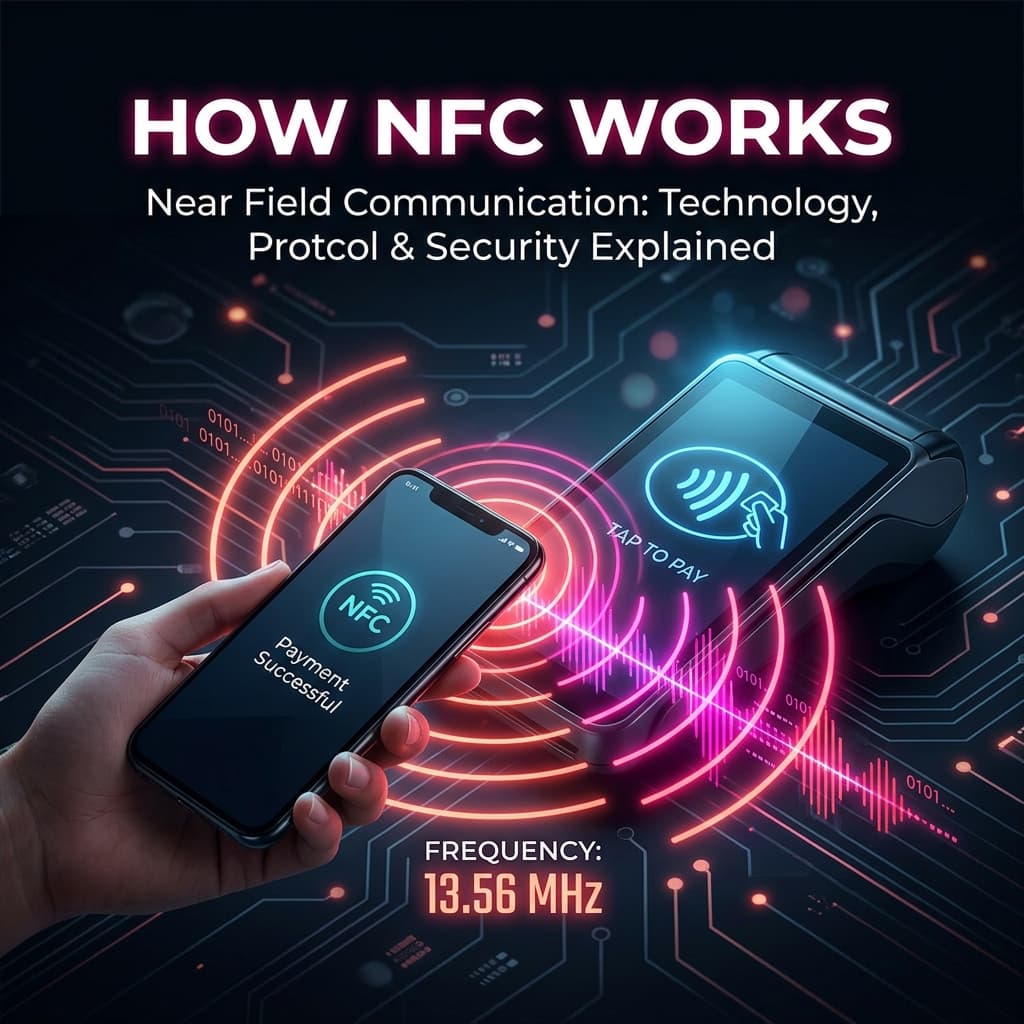
The Physics: How 13.56 MHz Inductive Coupling Transfers Power & Data
- [NFC reader] [generates] [13.56 MHz alternating magnetic field via antenna coil]
- [Passive NFC tag] [harvests] [energy from reader field to power its chip]
- [Load modulation] [encodes] [tag response data onto the carrier field]
The NFC reader drives a current through its spiral antenna coil, creating a 13.56 MHz alternating magnetic field. When a passive tag enters this field, mutual inductance couples energy into the tag's coil — like a tiny transformer. The tag rectifies this RF energy to power its microchip. To respond, the tag modulates its antenna load, which causes detectable variations in the reader's field (a technique called load modulation).
NFC Operating Modes: Reader, P2P & Card Emulation
📖 Reader/Writer Mode
Phone or reader actively generates the 13.56 MHz field. Reads/writes data on passive NFC tags (stickers, keycards, transit cards). Most common mode for RC522 modules.
📱 Peer-to-Peer (P2P)
Both devices actively generate fields alternately. Used for Android Beam, NFC business card sharing, and device pairing. Both devices must have active NFC hardware.
💳 Card Emulation
NFC-capable device (phone, secure element) pretends to be a passive card. Enables Apple Pay, Google Pay, transit card emulation. The Secure Element (SE) or Host Card Emulation (HCE) handles cryptography.
Frequently Asked Questions
How does NFC work physically?
NFC uses 13.56 MHz inductive coupling. The reader coil generates an alternating magnetic field. When a passive tag enters within ~10 cm, its antenna coil inductively harvests energy from this field to power its chip. The tag responds by load-modulating the field, which the reader detects as data.
What is the difference between NFC and RFID?
NFC is a subset of RFID operating exclusively at 13.56 MHz with peer-to-peer capability and NFC Forum standardization. RFID spans 125 kHz to 5.8 GHz, is often proprietary, and lacks P2P mode. Your contactless bank card is ISO 14443 — NFC-compatible.
What is NDEF and how does it format NFC data?
NDEF (NFC Data Exchange Format) structures NFC tag data. Each NDEF message contains records with a Type Name Format, record type (e.g., "U" = URL, "T" = text), and payload. Your phone tapping a URL tag reads an NDEF record and opens the browser automatically.
How secure is NFC for payments?
Very secure. Each transaction generates a unique cryptographic token — the real card number is never sent. AES encryption in the Secure Element and EMV challenge-response prevents replay attacks. The short 4 cm range makes eavesdropping extremely difficult.
How do I use NFC with Arduino using the RC522 module?
Wire RC522 via SPI: SDA→10, SCK→13, MOSI→11, MISO→12, RST→9, 3.3V, GND. Install MFRC522 library. Initialize with rfid.PCD_Init(). Detect and read cards with rfid.PICC_IsNewCardPresent() and rfid.PICC_ReadCardSerial(). RC522 reads ISO 14443A (Mifare) tags at 13.56 MHz.
Conclusion
NFC is a masterpiece of wireless engineering — a passive tag with no battery can be read from a moving phone in under 50 ms, while cryptographic tokens protect payment security better than the magnetic stripes they replaced. For makers, the RC522 module brings this technology to any Arduino project for under $2.