Rain Sensor (FC-37)
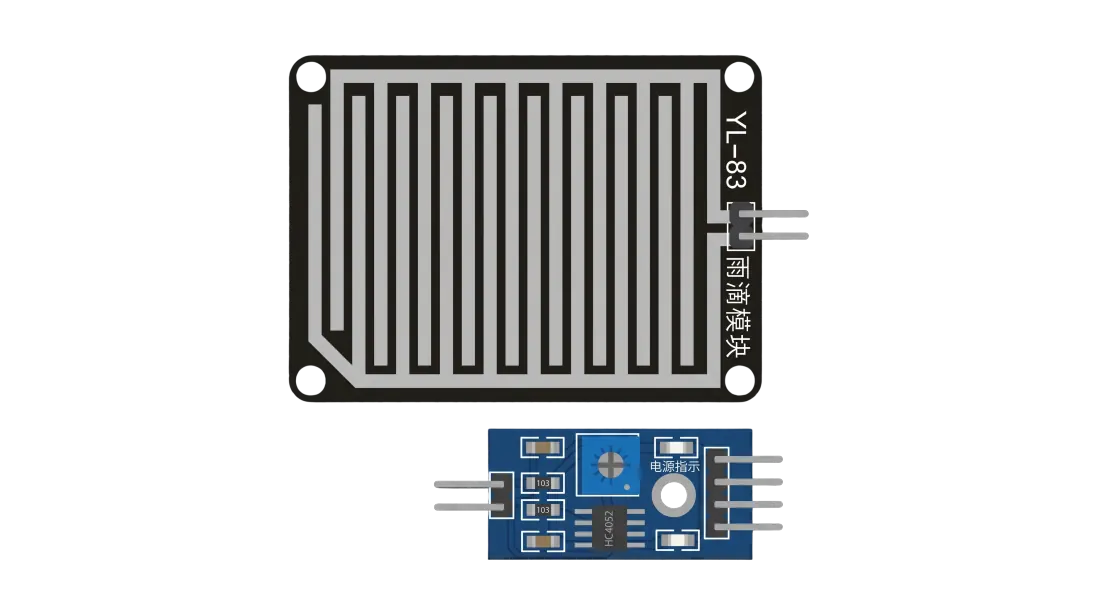
What is FC-37?
The FC-37 (also sold as YL-83) is a dual-part rain sensing system. It consists of a large, exposed sensing pad designed to catch water droplets, and a separate control module containing a comparator circuit.
When water falls on the sensing board, it bridges the interleaved nickel-plated copper traces, increasing the conductivity. This changes the board's resistance, enabling both detailed analog and digital output.
Key Features
Water Detection
Accurately senses rainfall, moisture, or condensation on the sensing board.
Anti-oxidation Pad
Sensing board is nickel-plated to resist corrosion and oxidation over time.
Dual Output
Supports both digital comparator output (DO) and high-resolution analog voltage (AO).
Sensitivity Control
Onboard potentiometer allows fine-tuning of the digital output trigger threshold.
Wide Voltage Range
Operates comfortably from 3.3V to 5V, making it highly compatible with modern microcontrollers.
Status Indicators
Onboard power LED and digital output status LED simplify testing and calibration.
Pin Configuration
VCC
3.3V - 5V Power Supply. Connect to your microcontroller's power output pin.
GND
Ground Connection. Connect to the common ground reference of your board.
AO
Analog Output. Outputs a voltage (0-VCC) that decreases as more water bridges the sensing pad.
DO
Digital Output. Outputs LOW when rain is detected (exceeds threshold) and HIGH when dry.
How It Works
The Science Behind It
Rain sensors work based on the principle of Resistance and Conductivity. The sensing pad consists of interleaved nickel traces that act as an open circuit.
When water droplets fall on the pad, they create a bridge between the traces. Since water is conductive (due to dissolved ions), the resistance decreases, allowing current to flow. The more water on the pad, the lower the resistance.
Resistance & Voltage Divider:
Dry Pad = Open Circuit (Rs ≈ ∞, Output ≈ 5V)
Wet Pad = Closed Circuit (Rs drops, Output drops toward 0V)
Wiring Tips & Best Practices
Mounting Angle
Mount the sensing pad at a slight angle (e.g. 15°-30°) so water droplets roll off naturally, preventing false positive readings after rain stops.
Electrolysis Prevention
Continuous power causes electrolysis, corroding the nickel traces. Connect the VCC pin to a digital GPIO pin and power it ONLY during readings.
Cable Placement
Keep the control board indoors or inside a waterproof enclosure, extending only the two-wire connection to the outdoor sensing pad.
De-bounce Readings
Wind and moving droplets can cause erratic readings. Apply a software average or debounce logic before triggering actions.
Periodic Cleaning
Clean the sensing pad periodically with isopropyl alcohol to remove dust, sap, or mineral deposits that build up and cause false triggers.
Potentiometer Tuning
Calibrate the potentiometer with a small water droplet on the pad to ensure the digital pin triggers reliably during light rain.